


If you’ve made it this far into researching answer engine optimization, you’re probably past “what is this” and onto the harder question. Is it actually worth spending time and money on. Here’s a straight answer, along with the timeline and the math behind it.
Is Answer Engine Optimization Worth It?
For most businesses that already put out content or run SEO, yes. And the reason is simple: AEO usually isn’t a new line item on your budget, it’s a redirection of work you’re already doing. Whether it’s “worth it” for you specifically comes down to what you’re comparing it against, and how patient you’re willing to be while it plays out.
Here’s the honest version of when it pays off and when it doesn’t:
| Situation | Is AEO Worth It? | Why |
|---|---|---|
| You already publish content regularly | Yes | Most of the work is restructuring what already exists, not building from zero |
| You have no content and no SEO history | Yes, but slower | You’re building topical authority and answer-first structure at the same time |
| You’re in a low-competition niche | Very much yes | Fewer sites competing for the same query means citations come faster |
| You need results inside a month | Probably not | AEO compounds over months, the same way SEO always has |
| You’re optimizing one page instead of a topic cluster | Weak return | AI models tend to cite depth, not isolated pages |
If there’s one pattern worth remembering here, it’s this: AEO rewards structure and depth over spend. A small business with a tight, well-built content cluster around one topic will out-cite a bigger competitor running scattered, unstructured content. Every time.
How Long Does It Take to See Results
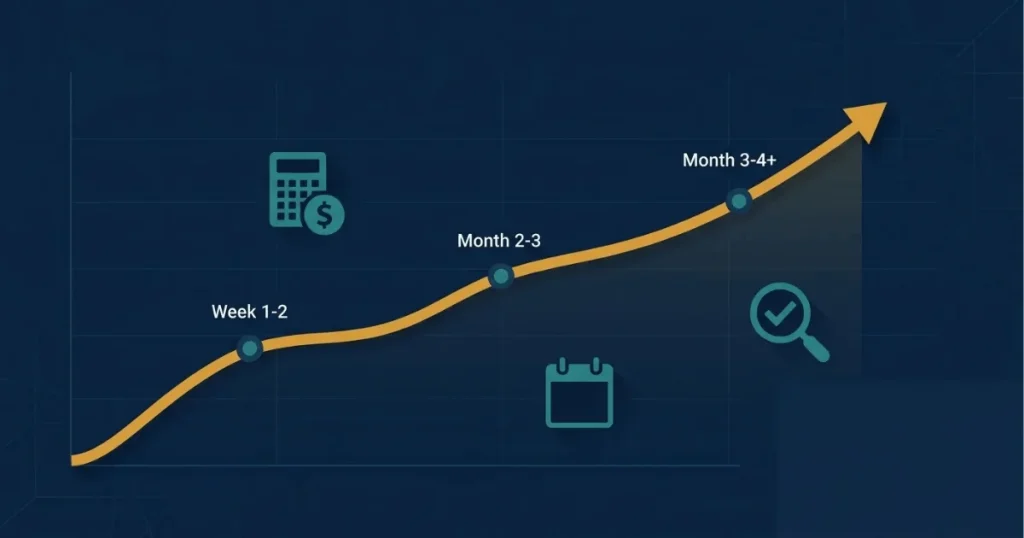
In our experience, most businesses see early signals within 4 to 8 weeks, with more consistent citations showing up by month 3 or 4, assuming the content was actually built for extraction and not just republished as-is. That range varies by niche and how much competing content already exists, so treat it as a general pattern rather than a guarantee.
Here’s roughly what to expect at each stage:
| Timeframe | What Typically Happens |
|---|---|
| Week 1-2 | Content published, schema live, page indexed |
| Week 3-6 | Occasional appearances in AI Overviews for long-tail, low-competition queries |
| Month 2-3 | Citations get more consistent, especially for questions your content answers directly |
| Month 3-4+ | Citations start showing up across multiple related queries as the cluster builds authority |
| Ongoing | Citations shift as competitors update their own content, so this isn’t a set-it-and-forget-it win |
A few things speed this up or slow it down. Domain authority helps, but it’s not the deciding factor the way it is in classic SEO. What moves the needle faster is how directly your content matches the exact phrasing people actually use, plus whether the technical basics are handled, schema that validates properly, pages that get crawled without issues. If your sitemap’s broken or your site’s blocking bots, none of this happens on schedule no matter how good the writing is.
Worth being upfront about one thing. If a competitor’s already dominating citations for your target queries and has been at it for a year, expect the slower end of this timeline. You’re not just building your own authority at that point, you’re pushing theirs out of the way too.
How to Calculate ROI for AEO
The simplest way to calculate AEO ROI: weigh the cost of producing and structuring your content against the value of the traffic, brand mentions, and conversions it eventually pulls in once citations start happening. Same basic logic as any other marketing channel. The attribution just works differently.
And that’s really the crux of it, the attribution. A lot of AEO’s value never shows up as a click. If ChatGPT names your brand in an answer and the reader never visits your site that day, that still counts for something, the same way getting mentioned in a publication people trust builds your reputation even if that particular reader doesn’t click through. According to Semrush research, the average AI search visitor converts at 4.4 times the rate of a traditional organic search visitor, which matters because it means the clicks you do get carry more weight, even if there are fewer of them.
Here’s a basic framework for putting an actual number on it:
| Step | What to Measure | How |
|---|---|---|
| 1. Cost | Content production, schema setup, ongoing updates | Hours spent x hourly rate, or the invoice if you outsourced it |
| 2. Direct traffic value | Visitors arriving from AI platforms | Search Console plus referral traffic from chat.openai.com, perplexity.ai, and so on |
| 3. Conversion value | Leads or sales from that traffic | Standard conversion tracking, segmented by AI referral source |
| 4. Citation value (the messy one) | Brand mentions without a click | Manual prompt testing, tracking how often you get named even without a visit |
| 5. ROI | (Traffic value + conversion value) minus cost | Same formula you’d use for any content ROI, just with an extra citation-value line |
If you’d rather skip the full tracking setup, there’s a rougher gut check that works too. Look at what you’re already spending on content or SEO. If restructuring that same content for AEO gets you cited even occasionally, on top of whatever organic traffic it was already pulling, the extra cost of the restructuring work is usually low enough that it pays for itself pretty fast. Definitely faster than running a whole separate campaign from scratch would.
If you want to try structuring things yourself first before deciding whether to hire it out, the full process is in our guide on how to do answer engine optimization.
If you’d rather skip the guesswork entirely, that’s exactly the kind of conversation worth having with someone who does this for a living. We handle answer engine optimization consulting for businesses that want the ROI math done properly instead of estimated off a blog post.
Is answer engine optimization worth it?
For most businesses already producing content, yes. AEO mostly redirects effort you're already spending into better structure rather than requiring a whole new budget. It matters less for a single isolated page and more once you've built out a proper content cluster.
How long does it take to see AEO results?
Based on our experience, early signals usually show up in 4 to 8 weeks, with more consistent citations by month 3 or 4, assuming the content is structured for extraction and the technical basics like schema and indexing are actually working.
How do I calculate ROI for answer engine optimization?
Weigh content production and structuring costs against direct traffic value, conversion value, and citation value (brand mentions that don't get a click), using AI referral traffic in Search Console as your main data source.