


If you’ve read our guide on answer engine optimization and you’re ready to actually implement it, this is the part where strategy turns into a checklist. Below is the full process: how to structure content, what to prioritize first, and how to check your progress against competitors who are already getting cited.
This guide walks through exactly how to do answer engine optimization, step by step, from structure to schema to tracking results.
If you’re wondering how any of this compares to traditional SEO, we’ve broken that down separately.
How to Do Answer Engine Optimization
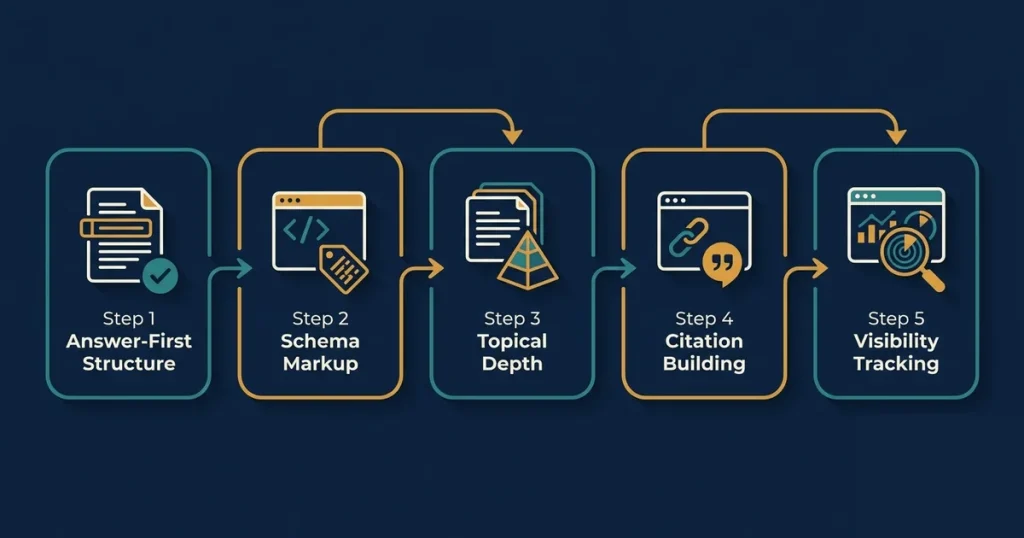
Answer engine optimization consists of five primary elements: structuring the content in such a way that the AI model can extract the desired direct answer from it, complementing this answer with schema markup, developing topical depth around the optimized topic or subject, securing citations from resources AI crawls and trusts, and tracking the appearance in the AI Overviews, ChatGPT, and Perplexity results.
None of these are optional. Skip schema and your content is technically readable but harder to parse structurally. Skip topical depth and you’ll get cited once, on one query, and nowhere else. Here’s the breakdown of what each piece actually involves:
| AEO Component | What It Does | Where to Start |
|---|---|---|
| Answer-first structure | Puts the direct answer in the first 2-3 sentences of every section | Rewrite your intros before touching anything else |
| Schema markup | Gives AI crawlers machine-readable context | FAQ schema and Article schema, minimum |
| Topical depth | Signals authority on the full subject, not just one keyword | Pillar + cluster architecture |
| Citation building | Gets your content referenced by sources AI models already cite | Original data, verified outbound links to Gartner/Semrush-tier sources |
| Visibility tracking | Confirms whether it’s working | Manual prompt testing across ChatGPT, Perplexity, Google AI Overviews |
The order matters less than people think. You can work on schema and content structure in parallel. What doesn’t work is doing citation building before your content is even structured to be citable in the first place.
Once manual prompt testing across platforms gets tedious to track by hand, dedicated tooling can take that tracking off your plate.
Answer Engine Optimization Best Practices
The single biggest best practice in AEO is writing the answer before you write the explanation. AI models pull the sentence that most directly answers a query, and if that sentence is buried under three paragraphs of throat-clearing, it won’t get pulled.
Getting this part right is really the foundation of how to do answer engine optimization well, since formatting decisions here affect everything that follows.
Beyond that, a handful of practices consistently separate content that gets cited from content that doesn’t:
- Lead with the answer, not the setup. First 2-3 sentences of every section should answer the question the heading implies. Context and nuance come after.
- Use headings as questions where it fits naturally. Not every H2 needs to be a question, but if people search it as a question, matching the phrasing helps.
- Keep answers self-contained. A model should be able to lift one paragraph or table and have it make sense without the rest of the article.
- Favor tables and lists over dense paragraphs for comparative or step-based information. Structured data is easier to extract and easier to cite accurately.
- Update content when facts change. AI systems weight freshness, especially for anything tied to tools, pricing, or statistics.
- Write for one clear entity per page. Mixing multiple unrelated topics on one URL dilutes what the page is actually “about” to a crawler.
One thing worth being honest about: none of this replaces having something actually worth citing. Formatting gets you noticed. Original insight, data, or a genuinely useful framework is what gets you cited repeatedly instead of once.
Checklist to Optimize for AI Answer Engine
Here’s the practical version, page by page. Run through this before you consider any AEO piece finished: Think of this as the master checklist for how to do answer engine optimization without missing a step.
| # | Task | Done When |
|---|---|---|
| 1 | Focus keyword set and matches search intent | Keyword reflects how people actually phrase the question |
| 2 | Direct answer in first 2-3 sentences of every H2 | No section makes the reader scroll to find the point |
| 3 | FAQ schema (JSON-LD) added and tested | Passes Google’s Rich Results Test |
| 4 | Article schema added | Confirmed in Rich Results Test or Schema Generator |
| 5 | At least one table or structured list per major section | Comparative/step data isn’t buried in paragraphs |
| 6 | Internal links placed inline, in context | No bottom-dump link lists |
| 7 | One verified outbound citation minimum | Linking to a source AI models already trust (Gartner, Semrush, CXL-tier) |
| 8 | Alt text and title on all images include the focus keyword | Check each image field individually, not just the file name |
| 9 | Content tested against 3-5 real prompts | Ask ChatGPT/Perplexity the target question, see if your page or brand shows up |
| 10 | Page indexed and crawlable | Confirmed in Search Console, not blocked by robots.txt or bot protection |
If you’re publishing on WordPress with Rank Math on the free tier, item 3 usually needs a manual JSON-LD workaround since FAQ schema is often a PRO-only feature. Article schema through the built-in generator is fine on free.
This checklist exists to make sure you’ve actually covered how to do answer engine optimization completely, not just the easy parts.
Answer Engine Optimization Competitor Analysis
Competitor analysis for AEO isn’t about checking who ranks higher in Google. It’s about checking who gets pulled into the AI answer itself, which is a different, smaller list.
Understanding this gap is a core part of how to do answer engine optimization strategically, not just mechanically.
Start by running your target queries directly through ChatGPT, Perplexity, and Google’s AI Overview, and noting which domains get cited. Then work backward:
- What format is the cited content in? Table, numbered list, definition-first paragraph, FAQ block.
- How deep is their coverage? One article on the topic, or a full cluster feeding into a pillar.
- What are they citing themselves? AI models tend to trust content that itself cites credible sources.
- How fresh is it? Check publish or last-updated dates where visible.
- What’s missing? The gap between what they cover and what the query actually needs is your opening.
A simple way to track this without expensive is a running spreadsheet: query, which domains got cited, content format used, and a gap note. After 15-20 queries you’ll start seeing patterns in what’s actually getting pulled versus what’s just ranking well in traditional search.
This matters because AEO and rankings don’t always match. A page ranking #6 organically can still be the one an AI model cites, if it answers the question more directly than the pages above it.
E-E-A-T for Answer Engine Optimization
E-E-A-T (Experience, Expertise, Authoritativeness, Trust) matters for AEO because AI models are, at their core, trying to avoid citing something wrong. Content that signals real experience and verifiable authority gets trusted as a source; content that reads like it was written to rank, without anyone behind it who’s actually done the thing, doesn’t.
This is often the piece people skip when figuring out how to do answer engine optimization properly, and it’s usually the reason otherwise well-structured content still doesn’t get cited.
| E-E-A-T Signal | How It Applies to AEO |
|---|---|
| Experience | First-hand detail, specific numbers, actual screenshots or examples, not generic advice |
| Expertise | Author bylines with real credentials, consistent subject-matter focus across the site |
| Authoritativeness | Other credible sites citing you back, mentions from recognized names in the space |
| Trust | Accurate, current information, transparent sourcing, no unverified claims |
Practically, this means a few things for how you build out content: put a real author name and bio on articles, keep outbound citations accurate and check them periodically, and don’t publish a “definitive guide” on a topic your site has no actual track record in. A generic AEO article from a brand-new domain with no author attribution is exactly the kind of content AI models are built to deprioritize as a source.
Schema Markup Importance for Answer Engine Optimization (AEO)
Schema markup matters for AEO because it tells AI crawlers exactly what your content is, structurally, instead of making them infer it from raw text. FAQ schema tells a model “this block is a question and its direct answer.” Article schema tells it “this is a standalone piece of content with this author, this date, this topic.”
The two that matter most for AEO specifically:
| Schema Type | What It Signals | Common Setup Method |
|---|---|---|
| FAQPage | Marks specific Q&A pairs as extractable answer units | Often PRO-only in plugins like Rank Math, so a manual JSON-LD block is the common free workaround |
| Article | Marks the page as a standalone content asset with author/date metadata | Usually available free via built-in schema generators |
If your SEO plugin’s FAQ schema is locked behind a paid tier, the workaround is a JSON-LD script added directly through a Custom HTML block, placed after your FAQ section. It takes longer to set up manually than clicking a toggle, but it produces the same structured output. Always verify it actually landed correctly using Google’s Rich Results Test before considering the page done. It’s common for a JSON-LD block to save at the widget level but not reflect at the live page level, which shows up as missing schema in testing even though it looks correctly placed in the editor.
How do I do answer engine optimization
Structure content with a direct answer in the first few sentences of every section, add FAQ and Article schema, build topical depth through pillar-and-cluster content, and earn citations from sources AI models already trust.
What are the best practices for answer engine optimization?
Lead with the answer before the explanation, use tables and lists for comparative information, keep each section self-contained, and update content when facts or tools change.u003cbru003e
How do I check my answer engine optimization checklist?
Confirm your focus keyword, answer-first structure, FAQ and Article schema, internal links, verified citations, and image alt text are all in place, then test the page against real AI prompts before calling it done.
How do I do competitor analysis for answer engine optimization?
Run your target queries through ChatGPT, Perplexity, and Google AI Overviews, note which domains get cited, and compare their content format and depth against your own to find gaps.
Why does E-E-A-T matter for answer engine optimization?
AI models avoid citing content that doesn’t demonstrate real experience or verifiable authority, so author credentials, accurate sourcing, and a consistent topical track record directly affect whether you get cited.
Why is schema markup important for answer engine optimization?
Schema tells AI crawlers explicitly what a block of content is, like a direct answer or a standalone article, instead of leaving them to infer structure from raw text, which makes your content easier to extract accurately.