


Answer engine optimization vs traditional SEO isn’t just a semantic debate. It’s the split that decides whether your brand shows up in an AI-generated answer or gets buried underneath it.
If you’ve spent any time reading about answer engine optimization lately, you’ve probably also seen GEO thrown into the same sentence, sometimes as if all three are interchangeable. They’re not, and mixing them up is how teams end up optimizing for the wrong output entirely.
This article breaks down what each term actually means, where the real boundaries are, and why the difference matters more now than it did even a year ago.
What Is Answer Engine Optimization?
Answer engine optimization is the practice of structuring content so AI systems, think ChatGPT, Perplexity, Google’s AI Overviews, voice assistants, can pull it out cleanly and use it as a direct answer. With your brand attached as the source.
It’s not about ranking a blue link anymore. It’s about being the sentence an AI system quotes or paraphrases when someone asks a question in that space.
The mechanics are different from what most SEOs grew up on. Instead of writing a page that slowly earns authority through backlinks and dwell time, you’re writing a page an AI model can lift a clean, self-contained answer from in the first two or three sentences.
That means clear question-based headings. Answers that don’t make the reader scroll for context. Structured data that tells the crawler exactly what it’s looking at.
Why Does Answer Engine Optimization Matter?
A growing share of searches never produce a click at all. The user asks a question, an AI system answers it directly, and the page that fed that answer gets credit (or doesn’t) without anyone visiting it.
AI Overviews already appear on more than 20% of Google searches. When they do, click-through rates drop by nearly 60%, according to Search Engine Land’s coverage of a 2026 zero-click search study.
That number changes what “ranking well” even means now. A page can sit in position one and still be invisible if the AI Overview above it never mentions the brand. AEO exists to close that exact gap, treating the answer box as its own competitive surface with its own rules for what gets cited and what gets skipped.
For a business, this isn’t abstract. It’s the difference between showing up when a potential client asks an AI assistant “who does AEO consulting,” and not existing in that conversation at all. No matter how well the site ranks the old-fashioned way.
Who Coined Answer Engine Optimization (AEO)?
There’s no single person credited with coining it. The term grew out of the SEO industry itself, once AI-powered “answer engines” like ChatGPT and Perplexity started pulling meaningful search volume away from traditional results pages.
SEOs needed a name for optimizing toward those systems specifically. “Answer engine optimization” stuck because it described exactly what was happening: optimizing for an engine that answers, not one that just lists links.
Worth knowing this isn’t a trademarked methodology or a framework owned by one agency. It’s still an emerging discipline, still being defined in practice, which is part of why definitions of AEO vary depending on who’s writing about it.
Does Answer Engine Optimization Replace SEO?
No. Treating it as a replacement is one of the more expensive mistakes a business can make right now.
AEO and SEO solve overlapping but distinct problems. Most of the technical foundation, clean site structure, fast load times, credible backlinks, clear on-page content, still underpins both. You don’t abandon SEO to do AEO. You extend it.
Where they actually diverge is what “success” looks like. SEO success is a ranking position and a click. AEO success is a citation, sometimes with a click, sometimes without one.
A business that drops SEO entirely to chase AEO will likely lose the organic traffic base that AEO citations often get sourced from in the first place. AI systems tend to cite pages that already carry some organic authority, not ones starting from nothing.
That’s the heart of the answer engine optimization vs traditional SEO debate. Not which one wins, but which job each one is actually doing.
Answer Engine Optimization vs Traditional SEO
The clearest way to see the difference is side by side.
| Traditional SEO | Answer Engine Optimization | |
|---|---|---|
| Primary goal | Rank in the top organic results | Get cited or quoted in an AI-generated answer |
| Success metric | Click-through rate, ranking position | Citation frequency, brand mention in AI outputs |
| Content structure | Long-form, narrative, keyword-woven | Direct-answer openings, scannable, question-based headings |
| Technical priority | Backlinks, page speed, crawlability | Schema markup, structured data, clear entity signals |
| User outcome | Visits the page | May get the answer without visiting |
Here’s the practical takeaway. If your content buries the actual answer three paragraphs into a section, under a clever headline written for a human scrolling past it, an AI crawler has to work harder to extract anything usable.
It’ll often just skip that page for a competitor’s cleaner one instead. How to do answer engine optimization covers the specific structural changes that fix this.
This is really what people mean when they compare answer engine optimization vs traditional SEO side by side: two different definitions of what “found” even means.
Answer Engine Optimization vs Generative Engine Optimization (GEO)
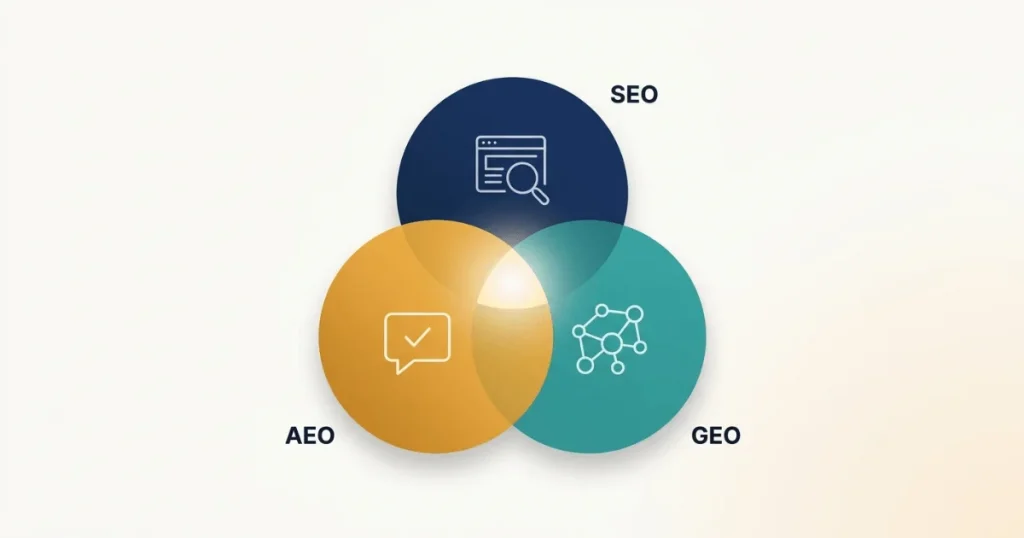
This is the pairing that confuses people most, because AEO and GEO genuinely overlap in places. Both are reactions to the same shift: search moving from a list of links to a generated response.
The difference is in what “generated response” actually means in each case.
GEO is the broader umbrella. It covers optimizing for any generative AI output, including long-form summaries, comparisons, and multi-source syntheses that pull from dozens of pages to build one answer.
AEO is narrower and more tactical. It’s specifically about winning the direct-answer moment: the featured snippet, the voice assistant response, the single sentence an AI system quotes when someone asks a specific, answerable question.
Think of it this way. If someone asks an AI assistant “what’s the best CRM for a 10-person sales team,” and the response synthesizes opinions from six review sites into a paragraph, that’s a GEO outcome. Your brand’s visibility there depends on how well six different pages, not just yours, positioned it across the web.
If someone asks “what does CRM stand for” and gets one clean definition with your brand cited as the source, that’s a much more direct AEO win.
In practice, most businesses doing this work end up doing both at once. The same structural discipline, clear answers, strong schema, credible entity signals, feeds both outcomes. The distinction matters more for how you measure success than for how you actually build the content.
Which One Should You Actually Prioritize?
For most businesses starting from zero, AEO is the more practical entry point. It’s more tactical, easier to measure through tools tracking AI citations, and it builds directly on SEO fundamentals you likely already have in place.
GEO strategy tends to matter more once you’re already generating consistent citations and want to shape how AI systems characterize your brand across broader, multi-source answers. That’s a longer game, and it makes more sense once the basics are already working.
Whichever framing you use, answer engine optimization vs traditional SEO isn’t a competition. It’s two layers of the same visibility strategy.
If you’re not sure where your content currently stands on any of this, answer engine optimization consulting is the fastest way to get a straight answer instead of guessing.
What’s the main difference between AEO and SEO?
Is GEO the same thing as AEO?
Do I need to choose between SEO and AEO?
No. AEO builds on SEO fundamentals rather than replacing them. Most of the technical groundwork, clean structure, fast pages, credible links, supports both at once.