


Answer engine optimization, or AEO, means writing and structuring content for AI platforms. Platforms like ChatGPT, Perplexity, Google AI Overviews, and Copilot can find and trust it. They can then use it to answer a person’s question directly. Traditional SEO competes for a spot on a results page. AEO competes for something different: the actual citation inside an answer the AI writes on the spot.
That difference is already showing up in the numbers. A large and growing share of searches now end without a click at all, because the AI answers the question right there. When that happens, ranking first on a page nobody scrolls down anymore doesn’t mean much. What matters is whether the machine trusted your content enough to quote it.
This guide explains what AEO is and how it works. It shows how AEO differs from SEO and GEO. It also explains what to do next. It lists tools that are worth paying for. It shows how to tell if any of it is working. Near the end, you’ll also find a simple five-point framework we use internally. It helps us score whether a page is citable and free to borrow from. You can also link back to it.
What is answer engine optimization?
Answer engine optimization means writing content so it becomes the source an AI system reaches for when it puts together an answer. That takes three things at once.
The content has to be easy to extract, meaning clear and direct rather than buried under paragraphs of setup. It has to be trustworthy, backed by real evidence and a real author. And it has to actually answer the specific question, not something loosely related to it.
This is a different job than writing for a click. A page written for SEO earns a ranking position and then convinces a human to visit.
A page written for AEO has to be read correctly by a machine, summarized without errors, and repeated back to a person, sometimes with a link attached and sometimes without one. Good AEO content still has to read well for a human too. If it only works for the machine and reads awkwardly to a person, it won’t hold up once it gets clicked on.
Who coined answer engine optimization?
None of one has come up with one particular individual or organization that is responsible for inventing the term. It was first used in relation to SEO in 2018, in connection with voice search and featured snippets, and acquired its modern meaning around 2023-2025, when the need to optimize for AI-generated answers became apparent.
The research behind the emergence of AEO is largely linked with the optimization for voice assistants, as they were previously the only source of “answer boxes” – the single response generated by the system, as opposed to dozens of results in regular search. Publications on Search Engine Land and Search Engine Journal also published articles on AEO in 2025, and the concept officially entered the industry lexicon.
Why answer engine optimization matters for modern brands
The case for AEO comes down to where research actually happens now. Several industry reports put the share of zero-click searches, meaning the user gets an answer without visiting a single website, at over half of all queries. Profound has pointed to Gartner’s prediction that traditional search volume could drop by as much as 25% by 2026 as AI answer engines absorb more of that demand, alongside OpenAI’s own reporting of hundreds of millions of weekly users.
It’s worth noting that prediction was aggressive, and actual search volume has held up better than Gartner projected so far. The direction is still real, just slower than the headline number suggested.
There’s also a quality angle. Visitors who click through from an AI answer tend to be further along in their decision, since the AI already did the comparison and filtering for them.
Semrush’s research has found that AI-referred visitors convert at meaningfully higher rates than visitors from traditional organic search. And even when there’s no click at all, getting named as a source still helps. It works the same way a mention in a trusted publication builds your reputation, even if that particular reader never visits your site that day.
How does answer engine optimization work?
Answer engines, whether that’s Google’s AI Overviews, ChatGPT with browsing turned on, or Perplexity, generally work in three stages. They pull a set of candidate sources for a query. They check which of those sources are clear and trustworthy enough to summarize without getting it wrong. Then they generate a response drawing from the sources they trust most, sometimes naming them and sometimes not.
The pages that make it into that final answer share a few habits. They answer the question in the first few sentences instead of building up to it slowly. They use headings phrased the way someone would actually ask the question out loud, not clever marketing phrasing. And they show real signs of who wrote them and when, through bylines, visible dates, and structured data the machine doesn’t have to guess at.
A quick example. Search “does answer engine optimization replace SEO” on Google right now, and the AI Overview that appears rarely comes from the page with the most backlinks. It comes from whichever page states the answer, “no, they work together,” in the first sentence, then backs it up. That’s the extraction test in action.
How do answer engines choose which sources to cite?
Determining a source is not about overall authority as Google’s classic ranking method. Answer engines consider a few factors.
They check if the page answers the query. They see if the facts match other trusted sources. They also check if the page is well organized. This helps the AI extract the answer without guessing the meaning.
A page with the right information buried in paragraph four, behind two unrelated tangents, loses out to a shorter page that states the answer plainly at the top.
Freshness plays into this too. AI topics move fast, and a page with a clear, honest “last updated” date lowers the risk that the AI cites something outdated CXL’s AEO framework treats content accuracy as ongoing maintenance rather than a one-time publishing task, which is a real shift from how most SEO content gets treated, where a page can sit untouched for years and still perform fine.
What role does schema markup play in answer engine optimization?
Structured data, typically found in the form of Schema.org markup such as FAQPage, HowTo, or Article schema, provide search engines with the ability to identify elements on a page without having to rely on pattern detection and extrapolation from the raw HTML code.
The schema.org markup, particularly the FAQ schema, helps answer engines identify the question-answer pair, as they are explicitly provided. It is worth mentioning that the technical guidance from CXL highlights structured data as one of the critical levers that a website owner can utilize, as it essentially removes ambiguity and allows for direct specification of the desired outcome.
What role does E-E-A-T play in answer engine optimization?
E-E-A-T stands for experience, expertise, authoritativeness, and trustworthiness. It began as a Google Search Quality Rater concept. It also applies to how AI systems judge if a source is safe to quote. A few signals matter most:
- A named author with real, checkable credentials, not “Admin” or no byline at all
- A clear about page that explains who’s behind the content
- Writing that reads like it came from actual experience with the topic, not a rewrite of someone else’s article
- Consistency between what the author claims to know and what the content actually demonstrates
This matters even more in health, finance, and legal content. Answer engines are often cautious about which sources they cite directly.
Answer engine optimization vs SEO vs GEO: what’s the difference?
These three terms get thrown around almost interchangeably, but they’re not describing the same goal.
These three terms get thrown around almost interchangeably, but answer engine optimization vs SEO vs GEO aren’t describing the same goal.
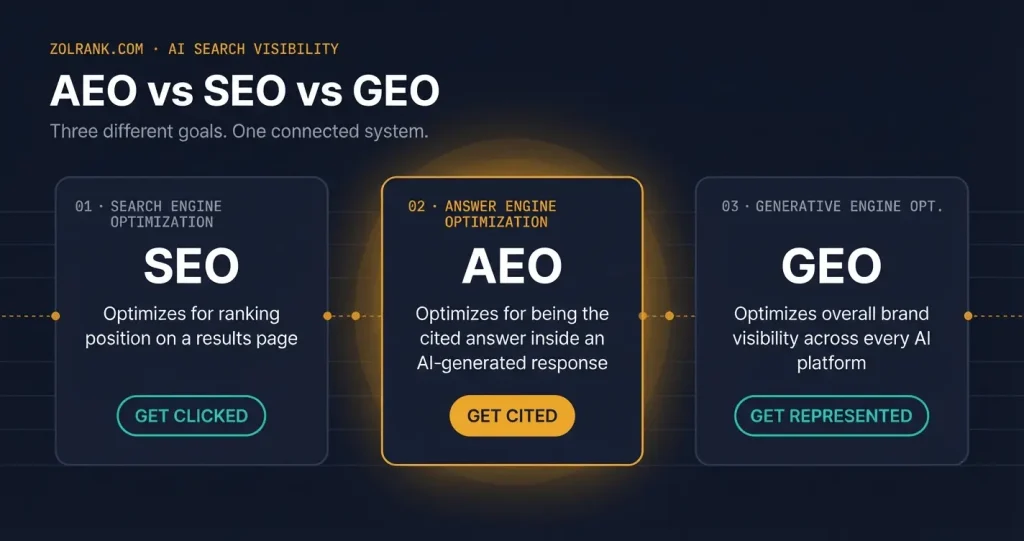
| Discipline | What it optimizes for | Primary goal |
|---|---|---|
| SEO (search engine optimization) | Ranking position on a traditional results page | Get clicked |
| AEO (answer engine optimization) | Being the extracted, cited answer inside an AI-generated response | Get cited |
| GEO (generative engine optimization) | Overall visibility and accurate representation across generative AI platforms | Get mentioned and represented correctly |
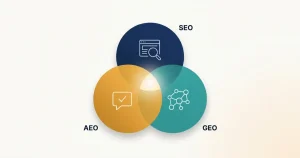
In practice these three overlap and reinforce each other rather than compete. Good SEO still gets a page indexed and found in the first place, since an answer engine can’t cite a page it’s never crawled. AEO then decides whether that indexed page is the one selected and quoted once the AI is putting its answer together. GEO sits above both, covering how a brand is represented across every generative AI surface a customer might use, not just single citations.
Does answer engine optimization replace SEO?
No, and this misconception comes up a lot. SEO and AEO solve two different problems that happen in sequence.
SEO gets your content found and indexed. AEO decides whether that found content is trustworthy enough for an AI to quote once it’s there.
A page can rank well in classic search and still never get cited in an AI Overview if it fails the extractability and trust tests above. Most technical SEO basics, like crawlability, page speed, and a clean site structure, are still needed for AEO. AEO does not replace them.
What is the difference between answer engine optimization and GEO?
AEO is the narrower, tactical piece: winning the specific citation for a specific question. GEO is the bigger goal.
It covers how a brand is shown, described, and recommended across the full generative AI ecosystem. This applies even when an answer has no direct citation. Think of AEO as a key tactic to reach the wider GEO goal.
It is like on-page optimization, which is one tactic within broader SEO work.
How businesses can improve answer engine optimization in 2026
Improving AEO isn’t a single fix. It’s a shift in how content gets written and maintained.
How to do answer engine optimization step by step
- Audit current content for easy extraction, clear structure, and freshness. Start with the most visited articles, not a full overhaul at once.
- Put the direct answer in the first two or three sentences. Then add background details or brand messaging.
- Structure headings as questions, using the phrasing someone might actually type into an AI search.
- Implement FAQ and Article schema markup on key posts and pages. This helps search engines detect the question-and-answer format easily.
- Leverage stronger authoritativeness by adding a byline, credentials, and an about page.
- Develop a pillar-post-and-cluster architecture. This helps you answer related follow-up questions, and it also keeps users on your site, not someone else’s.
- Focus on building off-site authority too. Make sure your information is consistent across directories and databases. Answer engines read these signals when they assess credibility.
- Finally, begin the process of auditing and updating content for the most heavily searched queries. Use a rotation system to keep your key business questions up to date. Check performance on ChatGPT, Perplexity, and Google AI Overviews. See which questions bring traffic. Also check if a competitor ranks ahead of your page in results.
Answer engine optimization best practices checklist
- Lead with a direct answer, skip the windup
- Use question-phrased headings that mirror how people actually ask
- Add FAQPage and Article schema to every priority page
- Show a real named author with checkable credentials
- Keep a visible “last updated” date, and actually update the content on that schedule
- Build connected topical clusters instead of isolated, one-off articles
- Keep business information consistent everywhere it appears online
- Credit your own sources accurately, since vague or unattributed claims hurt trust with both AI systems and human readers
The AEO citability framework
This is a simple way to score any page before you publish it. We call it the citability check, and it’s five questions, each worth one point.
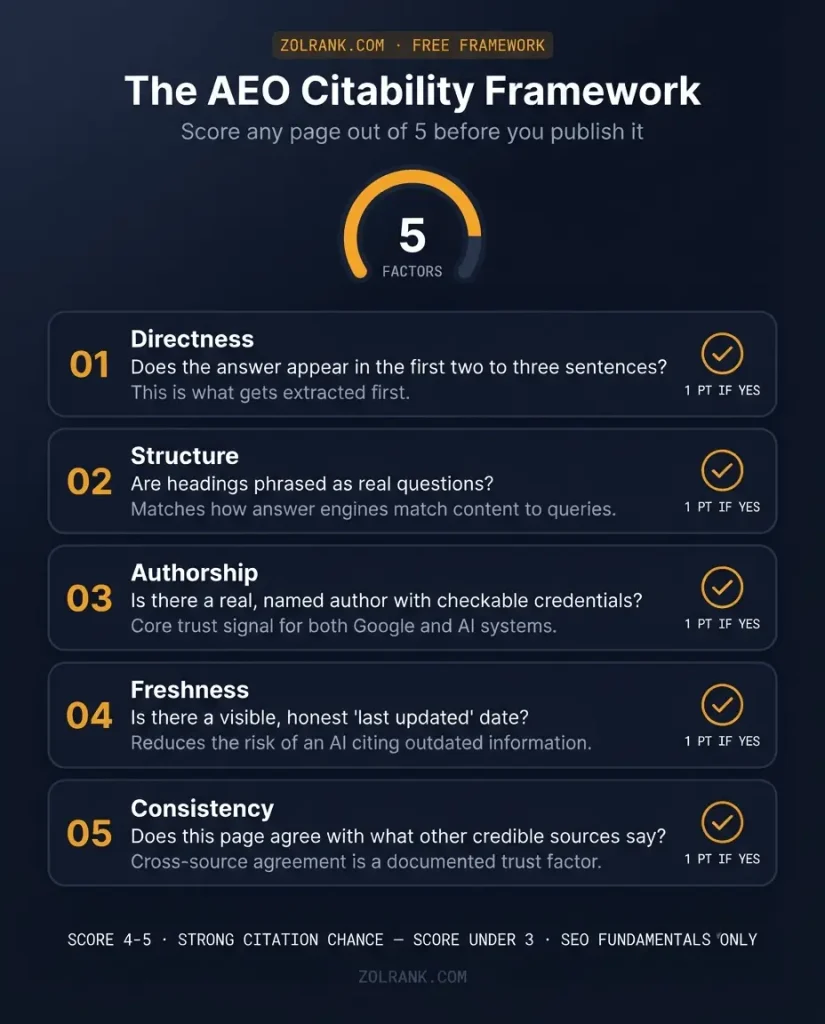
| Factor | Question to ask | Why it matters |
|---|---|---|
| Directness | Does the answer appear in the first two to three sentences? | This is what gets extracted first |
| Structure | Are headings phrased as real questions? | Matches how answer engines match content to queries |
| Authorship | Is there a real, named author with checkable credentials? | Core trust signal for both Google and AI systems |
| Freshness | Is there a visible, honest “last updated” date? | Reduces the risk of an AI citing outdated information |
| Consistency | Does this page agree with what other credible sources say on the same topic? | Cross-source agreement is a documented trust factor |
A page scoring 4 or 5 out of 5 has a real shot at getting cited. Below 3, it’s competing on SEO fundamentals alone. This framework is free to use on your own content, and if it’s useful, a link back is always appreciated.
What are the best tools for answer engine optimization?
A new type of software now tracks brand mentions and citation volume in AI answer engines.
This is different from traditional rank trackers that monitor brands in natural search results. The former usually reports how often a brand is cited or appears in ChatGPT, Perplexity, and Google AI Overviews. Some also offer competitive comparisons in the same interface.
For a full breakdown of specific platforms worth paying for, see our guide to the best AEO tools.
How to choose an answer engine optimization platform
Seek coverage in multiple search engine ranking tools, not just one. A tool only tracking Google AI Overviews will miss what’s happening in ChatGPT or Perplexity, which is an unacceptable risk given their large user bases. Focus on real citation discovery and tracking.
Do not use keyword-position tracking rebranded for AI results.
Make sure you can spot specific competitors.
Benchmark your performance against them.
Which answer engine optimization tools work best for AI visibility?
This depends on company size and budget. Bigger teams generally need multi-platform citation tracking, sentiment analysis, and competitor benchmarking in one place. Smaller teams and startups often do well starting manually.
They can ask ChatGPT, Perplexity, and Google the same key questions each week. They should log which sources get cited. Then they can pay for a dedicated platform once the habit proves its value.
Answer engine optimization services for different business sizes
What is the best answer engine optimization for large businesses?
Large multi-product or multi-location organizations typically need AEO at scale, meaning dozens or hundreds of pages using the same brand, and that’s where the pillar-and-cluster model comes in most useful. Without it, different pages compete with each other for visibility, diluting the potential traffic.
Big brands should keep product and company entity data consistent across all pages and platforms. Small brands have less risk of being listed incorrectly. Inconsistencies in large-scale organizations are a frequent cause of answer engines favoring smaller, more consistent brands.
For a full breakdown of what’s included at each pricing tier, see our guide to AEO services.
Is answer engine optimization worth it for small businesses?
Yes, and in some cases, smaller businesses have an advantage. In many ways, an AEO search favors quality over quantity.
However, the value of a well-worded answer to a specific question beats a generic response to the same query. A smaller site that has better answers to a particular question than a larger competitor ranks higher in search results. It requires less effort to optimize, which means that smaller sites have a lower barrier to entry than with traditional SEO methods.
If you want the full breakdown, including ROI math and how long it typically takes to see results, we’ve covered that in detail in our guide on whether answer engine optimization is worth it.
For teams without the internal bandwidth to run this process themselves, working with an answer engine optimization consulting partner is often the fastest way to close that gap.
How to measure answer engine optimization success
Click-through rates are an imperfect metric for AEOs since many successful citations would not generate a click, as the user would already have the answer they needed.
Instead, measure the number of times your brand is cited as a reference across your prioritized questions in ChatGPT, Perplexity, and AI Overviews. Measure conversions assisted by a visit to your site from any of these channels, and analyze the sentiment of any AI responses that reference your brand, since being cited incorrectly or unfavourably could be just as damaging as not being cited at all.
How long does answer engine optimization take to see results?
Most well-optimized pages show early movement within 60 to 90 days, especially on narrower questions with less competition around them. Broader authority across a wider set of related questions usually takes 6 to 12 months to build, as the pillar-and-cluster structure matures and off-site consistency signals add up. That timeline lands close to traditional SEO, though what you’re actually tracking looks different.
How to calculate ROI for answer engine optimization
Since a citation often doesn’t lead to a click, ROI has to account for value beyond last-click attribution. A workable approach: track how often your priority questions are being asked across AI platforms, your share of citations compared to named competitors, any assisted conversions you can trace back to AI-referred sessions, and a fair qualitative value for showing up consistently and accurately in a category your buyers are actively researching.
Frequently asked questions about answer engine optimization
What is answer engine optimization in simple terms?
It’s writing and structuring content so AI tools like ChatGPT and Google AI Overviews can understand it, trust it, and quote it directly when someone asks a related question.
Does answer engine optimization replace SEO?
No. SEO gets your content indexed and found in the first place. AEO decides whether that same content is what an AI system picks to cite once it’s building its answer. They work together, not against each other.
How is AEO different from GEO?
AEO is the specific tactic of winning a citation for a given question. GEO is the broader job of managing how a brand gets represented, mentioned, and recommended across every generative AI platform, not just in single citations.
Is answer engine optimization worth investing in?
For most brands, yes. A large share of research now happens through AI answer engines without a single click to a traditional results page, and being absent from those answers means being invisible to that whole audience.
How long does it take to see AEO results?
Early signals often show up within 60 to 90 days on well-optimized, narrower pages. Broader authority across a wider set of related questions usually takes 6 to 12 months to build.
What’s the single most important AEO best practice?
Leading with a direct, complete answer in the first few sentences. AI systems favor content they can pull cleanly, without having to infer the answer from everything around it.
Who coined the term answer engine optimization?
No one person can take all the credit. It was first used in early 2018 by a voice search SEO writer, and finally given an official AI specific definition somewhere between 2023 and 2025 when various SEO pubs started writing articles about it.